
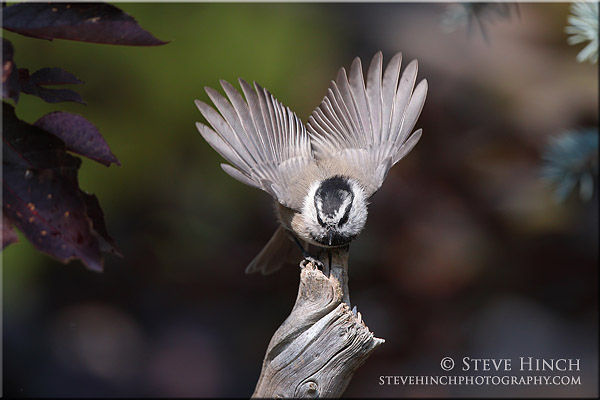
In July, I made a post about camera setting I use. That article can be found here. I intended to make a follow-up post much sooner than now, but I finally found the time to write a little more than I usually do. Previously I wrote about the camera type, white balance, shooting mode, and metering. This time I’ll touch on shutter speed, aperture, and ISO. These three settings all tie together. I’ll start with shutter speed. Shutter speed is how fast the camera’s shutter opens and closes. The shutter opens to allow light to reach the sensor. I’m most concerned with shutter speed when photographing wildlife and usually I’m looking for a fast speed to stop movement. In the above photo of the mountain chickadee, I need a fast shutter speed to capture the fast moving bird. In order to achieve the fastest speed, I need to also understand the aperture and ISO. A wide open aperture and higher ISO help to attain a fast shutter speed.
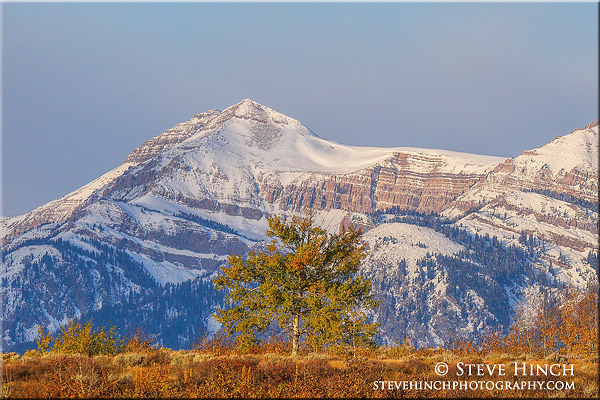
Aperture. While in the chickadee photo I was needed the fastest shutter speed possible, in the above scenic, shutter speed wasn’t important. What is important is that both the near tree and distant mountain are in focus. The camera’s aperture setting is how large the opening will be to let in light to the sensor. The smaller the number then the larger opening. For example, f5.6 is a wide or large opening while f22 is a small opening. Large openings such as f4 or f5.6 also means that the range of focus is very narrow meaning parts of the photo further away from the focus point will be out of focus. A smaller aperture such as f16 means there will be a greater range of focus and more of the scene will be in focus. This is important in both of the above photos because in the chickadee photo, not only do I need a fast shutter speed but I also want the background to be out of focus so the bird stands out well. By using a large aperture of f5.6, I not only get a faster shutter speed but also get an out of focus background. In the mountain photo, I need a greater range of focus. Since there is relatively no motion in the scene and I am using a tripod then I am not as concerned with shutter speed, so I am choosing a f-stop, or aperture setting, that gives a greater range of focus, in this case, f11. ISO. The third part of the equation is ISO. Higher ISO’s result in more noise in the photo file which is generally undesirable. Newer digital SLR cameras can handle higher ISO’s with less noise, but it’s still a concern. So usually I try to use the lowest ISO I can in order to achieve the desired shutter speed and/or aperture. That said, noise can be handled in post processing on the computer, so getting usable shutter speeds and/or apertures is a priority over a lower ISO and I will go higher as needed. I do try to not go over an ISO of 1600 unless I absolutely need to, but that’s just a personal rule. All of this leaves one more question, I think, and that is what mode to shoot in; aperture priority, shutter priority, or manual. I’ll go over these three settings and which I use and when, in another article in the near future.
 steve hinch photography