Something a Little Different (I think…)

Chief Mountain. Canon R5, 400mm, handheld, 1/160 @ f11, ISO 400

Chief Mountain sits on the border of Glacier National Park and the Blackfeet Indian Reservation, partially in both locations. At 9,080 feet it’s certainly not the tallest mountain in the area, but it’s rugged shape certainly define it as a dominant landmark and one that was used by Native Americans and early explorers. Glacier National Park isn’t really known for it’s fall color but there are areas where some brilliant stands of deciduous, mostly aspen, trees can be found. I used a telephoto lens to create this image, showing a different angle on Chief Mountain and where the morning light added nice warm tones to the colorful autumn aspens.
Frost

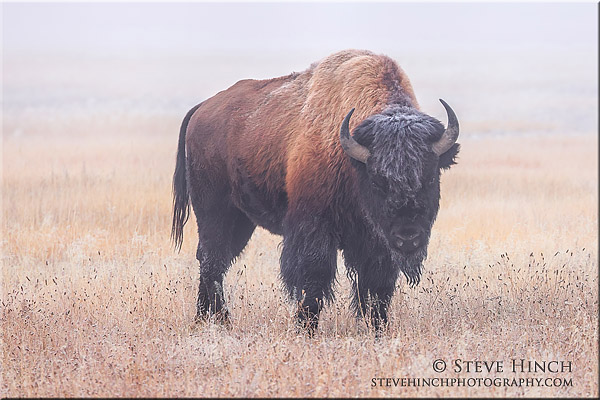
Frosty Bison. Canon R5, 400mm (cropped), beanbag, 1/400 @ f8, ISO 1600

This is another image from the last couple of days before Yellowstone closed for the season. The road from Gardiner, Montana to Mammoth Hot Springs and out through Lamar Valley to Cooke City is open year round but all interior roads, including those to Canyon, Old Faithful, and Yellowstone Lake, are all closed to vehicles until spring. A lot of Yellowstone above about 7,500 feet had snow on the ground but the west part of the park was mostly snow free, though that has likely changed over the past several days. Even though there was no snow where this bison was hanging out, it was still cold, about 20 degrees Fahrenheit. That, along with the fog, left many of the bison sporting a little frost on them.

End of Another Summer Season

Wolves in Yellowstone. Canon R5, 500mm (and cropped), beanbag, 1/800 @ f8, ISO 3200

As of yesterday most roads in Yellowstone National Park have closed for the 2022 summer season. In less than two months they’ll re-open to guided oversnow vehicles for the winter season. Back in May I had a pretty cool viewing of a wolf and my season ended with another pretty cool encounter a few days before the park closed. The light was pretty low with clouds and fog and the wolves were a bit too far out for even my longest lens, so the quality on this isn’t that great, except for viewing on the internet, but the moment was pretty cool so I had to share. Seven members of this pack (six seen in this photo) had regrouped and had a howling session for several minutes. Once they were done greeting each other, they quickly moved off into the trees behind them.

Black Bear Yellow Leaves

Black Bear. Canon R5, 400mm beanbag support (from my car), 1/1000 @ f8, ISO 800

I didn’t see much wildlife during my road trip at the beginning of October. I saw a few deer in Banff along with some birds. Most of the birds were familiar though I did pick up three new lifers bringing the total number of birds species I’ve photographed to 227. In Glacier, I hoped to see a bit wildlife more but was regulated to one bighorn sheep and this black bear. At sunrise, the bear was way up on a hillside but a few hours later, I found him by the roadside as he moved along in search of food. The shadows on his face I found to be unfortunate but this was the only image I was able to capture where he had his head up. Do note, this was taken from my car using a long lens with a beanbag to support the camera and lens.

Iconic Locations

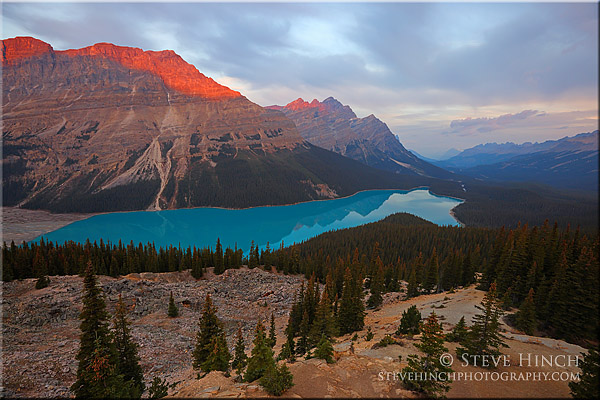
Peyto Lake. Canon R5, 16mm, tripod, 1/50 @ f11, ISO 500

There are many places that when you see an image you immediately know the location, place, or national park. These locations are considered iconic because you immediately know it, even if you haven’t been there. And they’re usually iconic for a reason. In the national parks, it’s usually due to natural beauty and relative ease of access. Alberta’s Banff National Park is a park full of icons. As I drove through the town of Banff, I immediately recognized Mount Rundle even though it was my first time actually seeing it. Moraine and Louise Lakes are both easily recognizable too. But Peyto Lake was without a doubt my favorite iconic location in Banff, so much so that I went there twice. Both mornings provided some of the best light of the entire trip. When traveling to new places, I use an app that shows what direction the light at sunrise and sunset will be in relation to various subjects. So I knew the light would be fantastic here. That, and the first morning I had this spot all to myself, unlike the other iconic locations. On the second morning, a few other people were at the overlook with me enjoying this beautiful scene. The blue color of Peyto Lake is real and is due to the lake being fed by Peyto Glacier just a short distance away. Since in my last post where a cloud looked like a bird, does anyone else see the shape of a dog in the lake?

Soaring at Sunset

Sunset over St. Mary Lake. Canon R5, 45mm, tripod, 1/20 @ f11, ISO 400

After finishing up in Banff National Park, rather than driving 12 hours straight back to my home in Montana, I decided to camp in Glacier National Park. I’ll be posting more from both Banff and Glacier in the coming weeks. I’ve enjoyed October in Glacier before and often found myself the only person camping. Not this year as the campgrounds were full despite so much being closed for the season. So I opted to just stay one night. But I was treated to a pretty stunning sunset and then the next morning to a great sunrise as well. The light at Wild Goose Island Overlook teased for a while before the sky went totally gray. With sunsets though, always wait until 10 or 15 minutes after the sunset time. I did and the sky lit back up beautifully. The cloud in the middle right of the sky looked like a giant bird flying above the lake and was part of the reason I chose this composition.

Larch… A Few More

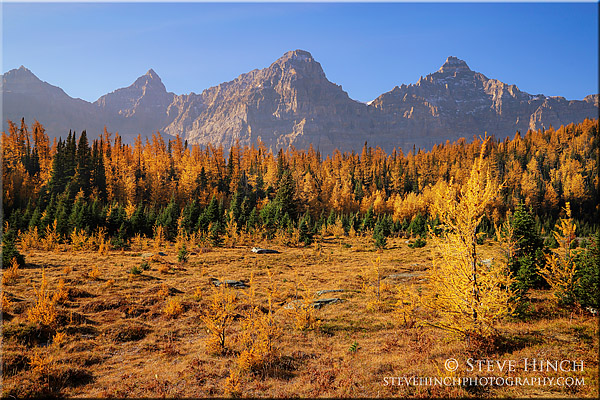
Larch Trees and the Canadian Rockies. Canon R5, 30mm, handheld, 1/400 @ f11, ISO 400

Usually for late September and early October I’m off looking for peak color aspen. but this autumn, as I mentioned previously, I wanted to do something different. I hoped to photograph larch, a deciduous pine, at peak color and what better backdrop for peak larch color than the Canadian Rockies. I can’t believe I had never ventured into Canada before, but I was in love with the scenery immediately. The hike to this location was popular but not as crowded as I expected based on everything I’d read (it was still busy though). The light was a bit challenging and I certainly would have liked a few clouds, but the color in the larch was stunning and the scenery couldn’t have been better.

Autumn in Canada

Bow Lake. Canon R5, 16mm, handheld, 1/200 @ f11, ISO 640

I recently returned from my first ever trip to Banff National Park in Alberta, Canada. I’m surprised I’ve never been motivated to make this trip before and it was actually my first ever trip to Canada period. I timed it to coincide with the change in foliage for peak autumn color and wasn’t disappointed. Most of my trip was met with clear blue skies, which is great for vacations but not so great for photography. My last morning however had some great skies and I knew I wanted to capture the autumn color in the willows at Bow Lake. I had this spot already picked out from a previous day and headed there at first light and it was probably one of my favorite images from the trip.

Autumn Goats

Mountain Goat Nanny and Kid. Canon R5, 200mm, handheld, 1/1250 @ f8, ISO 800

This is another image of the nanny and kid that I shared at the end of September. This was such a magical morning with great subjects, great light, and great backgrounds. Again, when photographing subjects in changing light, I’ll often spot meter where I want the proper exposure and then set it in manually. In this instance, I metered off the sunlit side of the goat and opened up about 2/3rds of a stop and set that exposure into the camera manually. With the Canon R5, which was exposure simulation as a feature, I can quickly change the exposure and immediately see the change without even needing to take a photo. This has made working a scene where there is highly variable light much more manageable and not blowing the exposure.

Larch

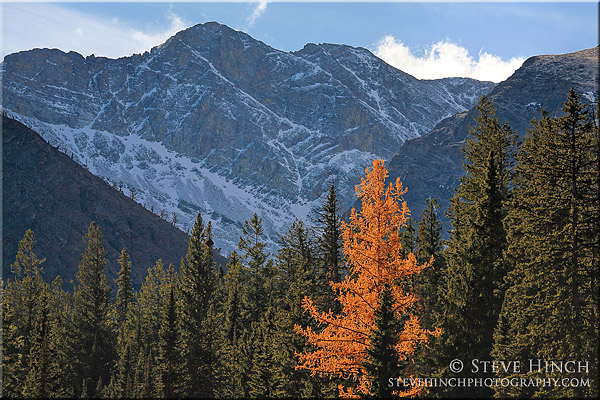
Golden Larch. Canon 5D2, 200mm, tripod, 1/100 @ f16, ISO 100

For this autumn, I decided to do something different. Usually I’d be scouting out aspen locations for peak color while also keeping an eye out for moose and elk during their ruts. This year I decided to target some different subjects. The larch tree is a northern species of pine but this pine tree actually turns a brilliant gold color in the fall and will drop it’s needles. After being bare over the winter, the needles will grow back again in the spring. The photo above was taken in Glacier National Park a few years ago.