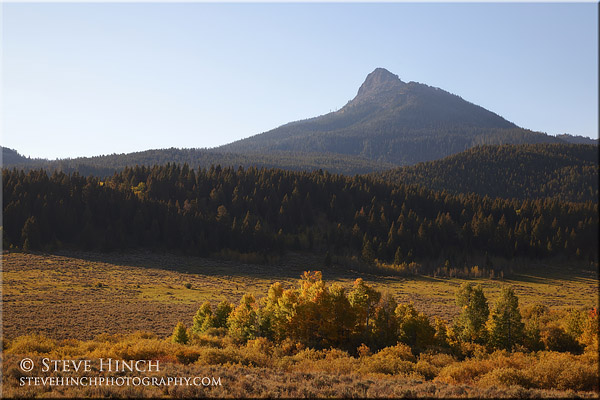
Autumn Colors and Sawtell Peak. Canon R5, 70mm, handheld, 1/640 @ f11, ISO 800
So it’s late September and the official first day of autumn is recently passed. Fall colors are popping up throughout the Yellowstone region and will work their way down to lower elevations over the coming weeks. Right now so areas of aspens are in peak color while others are still green. A big shift in autumn color should take place in the next week especially as the weather has turned cooler and more fall-like. This image was taken a few days ago and shows a stand of aspens nearing peak color while the surrounding willows are were very close to peak. Typically aspens turn first followed shortly after by the cottonwoods, which are the two primary sources of deciduous forest in the area.
Earlier this summer I was finally able to photograph some moose calves after several years of trying unsuccessfully. This little one was photographed from my car using a beanbag support to hold the long telephoto lens I was using. I shared an image on my blog previously of the first moose calf that ended my drought but never got around to sharing this one. By mid-September, moose calves will have their adult coats of dark brown and will look much different than they did just a few months ago.
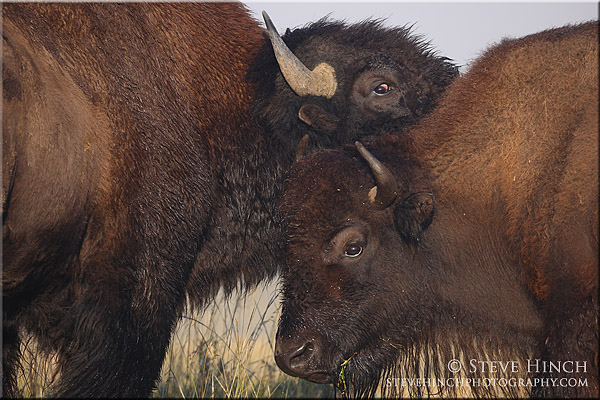
Bull and Cow Bison. Canon R5, 400mm, beanbag support, 1/1250 @ f8, ISO 1000
This summer has flown by and I can’t believe it’s September already. I took a two month break from social media and it did cause a slow down in posts I’ve done on my blog as well. But I’m going to try to get back into the swing of things and will try to post more again as time allows. September brings in autumn weather to the Yellowstone region and sees the bison breeding season come to a close. This photo was taken on August 24th and the breeding season was still happening. The bull bison were aggressive, as always, and I stayed in my car and used it as a photo blind for safety. If you met me at a book signing this summer we may have discussed how I like to use my car as a photo blind for safety reasons and also because wildlife tend to be less wary of a vehicle compared to a person, even in national parks.
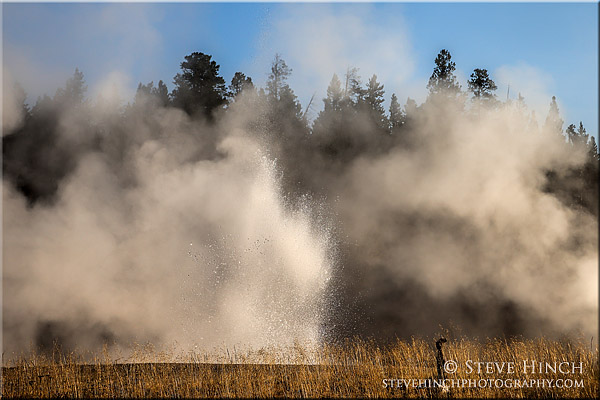
I finished my last book and print signing in Yellowstone on August 25th. It was a wonderful time to meet visitors in Yellowstone and talk about the park. I did a total of 15 signings over the summer with the majority of them at the Old Faithful Inn. My day usually started with a sunrise walk around one of the park’s geyser basins. It is illegal to walk off the boardwalks so many geyser and hot spring photos tend to look the same. I decided I wanted to try to do something unique with my images while still staying safe and following park rules. The first choice was to obviously shoot in some unique and different light conditions. For this post I’ll share three different photos of Sawmill Geyser which is located in the Upper Geyser Basin, home of Old Faithful. The photo above is a pretty standard image of Sawmill in eruption. The early morning light creates some nice color and detail in both the eruption and foreground. One of the challenges of Sawmill, as with many of the thermal features, is that the boardwalk is visible from almost every angle. It’s to the left of the geyser in the above photo but isn’t too distracting.
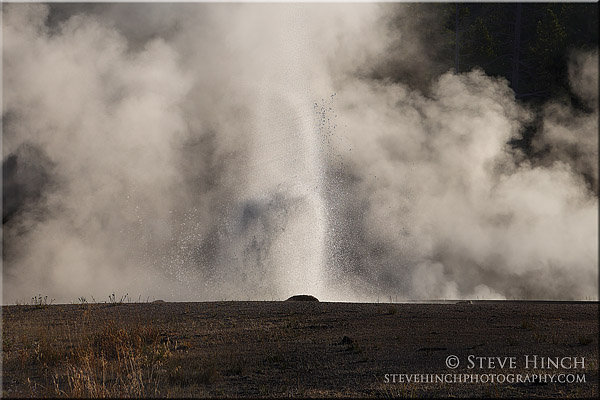
I opted to try to get some angles where the boardwalk wouldn’t be visible. The second image was backlit, which means the sun is behind, or almost behind, the subject which again is Sawmill Geyser. I only had a 24-105mm lens with me, so I did crop the second and third images into the composition I was working towards. The boardwalk from this angle is actually coming up from a bridge over the Firehole River so it gives a unique low level perspective. But there are two large information signs directly behind the geyser. I needed to wait until the steam obscured the signs. It was a cool morning, so there was a lot of steam and it wasn’t hard. I worked for this image which is more abstract than the first one due to the low angle and backlighting but the sky and trees in the background provide perspective that prevent the scene from being total abstract, which was my next goal.
Sawmill Geyser. Canon R5, 105mm, 1/1600 @ f8, ISO 400
I moved up the boardwalk a little more but it was still below Sawmill Geyser at this point. I still needed a lot of steam to obscure the signs and the boardwalk does become visible again to the right of the image though it’s all dark so mostly unrecognizable. The foreground grass still provides a little perspective to the scene. But the backlighting here really creates a largely abstract interpretation of a Sawmill Geyser eruption that is quite different than the first image even though they were taken only three minutes apart.
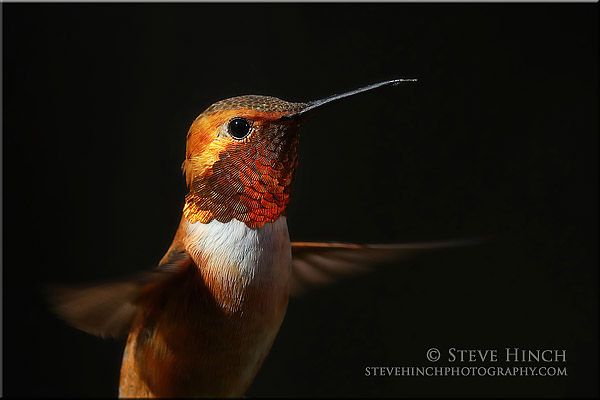
Male Rufous Hummingbird. Canon R5, 500mm + 1.4TC, tripod, 1/4000 @f8, ISO 1000
The hummingbirds have been slow to show up this year, for whatever reason. I’ve only seen one or two outside at a time. Typically at this point of the summer I’ll see as many as ten. This male was a visitor for about two weeks to start July. I’ve printed this as a metal print and have been displaying at my book and print signings in Yellowstone over the last month and it’s received a lot of attention. Even at 1/4000 of a second, there is still blur in his wings. Typically to get the wings with little to no blur I need to shoot at about 1/5000 of a second or higher but I feel the wing blur here works nicely.
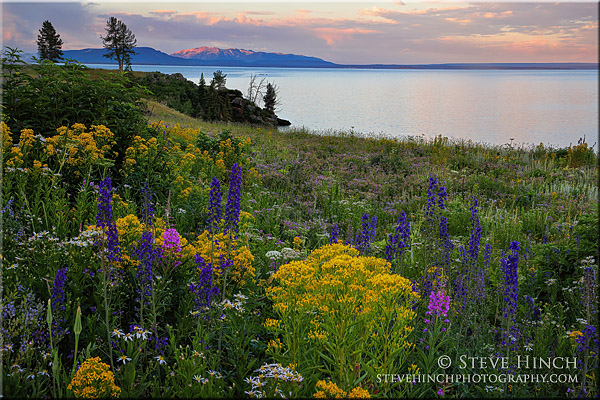
Summer wildflowers and Yellowstone Lake. Canon R5, 50mm, handheld, 1/40 @ f16, ISO 800.
Last week I had a book/print signing at Lake Hotel on the north shore of Yellowstone Lake. Naturally I had to get out and photograph the sunrise on the lake. I had scouted this location out the prior day and knew I wanted to give it a shot at sunrise. I had hope for better clouds but you get what you get and make the best of it. I opted to wait for the early light to hit Mount Sheridan in the distance and feel it was worth the wait.
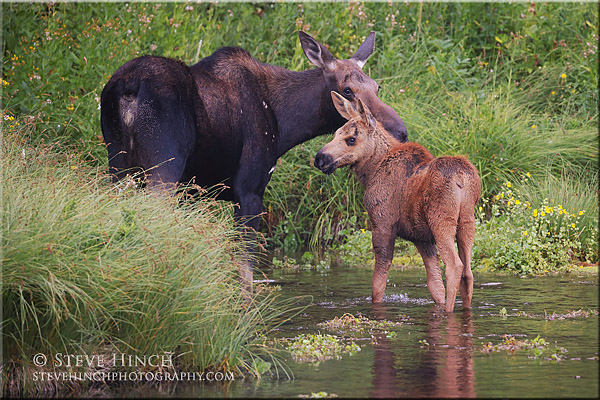
Moose and Calf. Canon R5, 400mm, handheld, 1/320 @ f5.6, ISO 1600
The last three years in June and July, I’ve spent a lot of time actively looking for moose calves to photograph but have been unsuccessful. While I have found none of those previous encounters led to any photos. This week that streak finally ended when I came across this cooperative mom and calf. I was able to spend about half an hour with these two as they grazed in the water and moved around. Mom was mostly interested in eating but the youngster seemed more involved in exploring.
Mountain Goat at Sunrise. Canon R5, 400mm, handheld, 1/4000 @ f8, ISO 400
I went back out looking for mountain goats recently. At first none were seen so I enjoyed the alpine flowers that were blooming. After about half an hour, this goat showed up. It was the only one but the backlit scene shortly after sunrise was certainly beautiful. It was incredibly windy at the summit so I didn’t stay around too long and opted to go looking for moose which proved to be unsuccessful. Nonetheless with this image, I felt the morning was a good one.
The hummingbirds returned this week, almost to the day as the same time last summer. The first one we noticed buzzing around our flowers was a male rufous hummingbird, possibly this one. I’ve seen two males and at least one female or immature hummingbird so far. If previous summers are an indicator, many more should start arriving soon. These birds are tough to photograph given their size as one of the smallest birds in North America and the fact they are rarely still when in flight. But it feels very rewarding when I’m able to get a few decent photos.
Arrowleaf Balsamroot and Mount Washburn. Canon R5, 16mm, handheld, 1/500 @ f14, ISO 800
I recently took the road over Dunraven Pass looking for wildflowers but the cold low temperatures the previous few mornings had taken their toll. While the flowers didn’t impress, the clouds above Mount Washburn were pretty cool and made the scene worthy of trying to photograph it. On a side note, I’ve been meaning to mention for a while now about the road construction in Yellowstone this summer. There is a lot of it going on, some long-term projects that will last all summer and others are minor projects that last a few days or weeks. Either way there is a lot of road work happening and plan accordingly, meaning bring plenty of patience.





 steve hinch photography