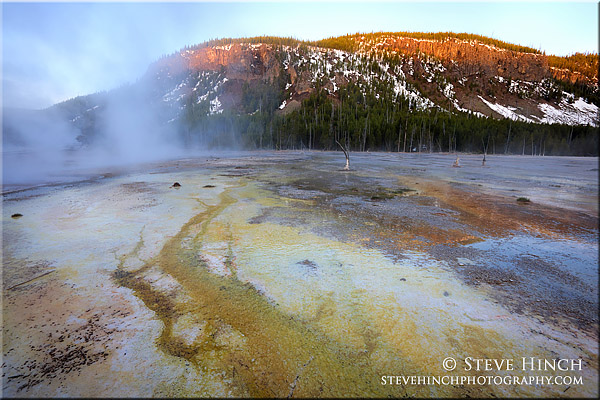
So I’m back again after largely taking the winter off from photography. I had my first book and print signing of the summer last week and it went really well. It feels good to be back at the Old Faithful Inn as well as out photographing. In my opinion, this image reflects Yellowstone well; so much of what you see is due to volcanic activity, from the steam rising from the geysers to the left, to the colorful bacteria growing in the warm water from the hot spring behind, even to the distant cliffs composed of rhyolite.
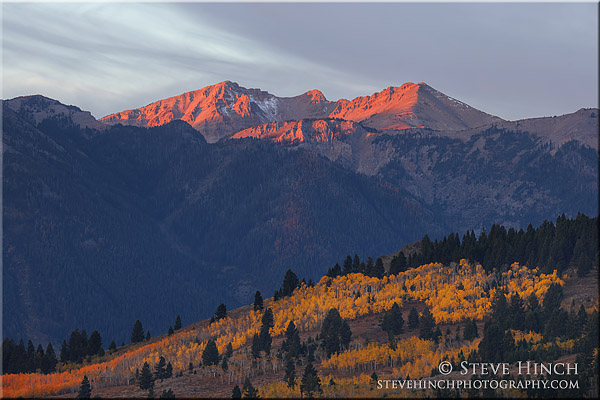
Mount Jefferson. Canon R5, 200mm, tripod, 1/25 @ f11, ISO 400
Late September into early October proved another productive autumn photo season for me again. Last year I traveled and took advantage of a long foliage season but this year I stayed close to home. For this post I want to share one of my favorite local mountains with fall colors. Mount Jefferson straddles the state line between Idaho and Montana and is the tallest Centennial Range. Due to its location, both the images I am showing here were shot with moderate telephoto lenses with the one above shot at approximately 200mm shortly after sunrise.
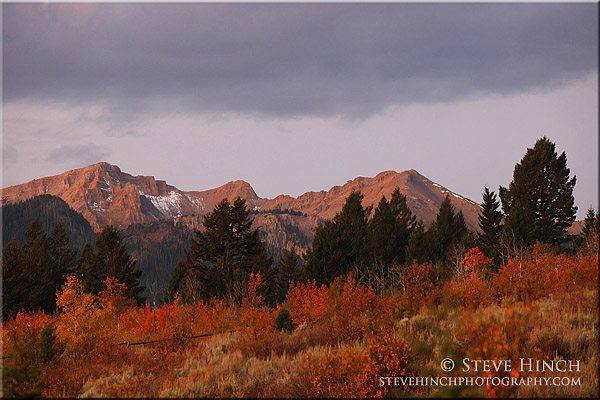
Mount Jefferson. Canon R5, 300mm, tripod, 1/40 @ f8, ISO 1600
This next image was taken at 300mm. It was very low light and the mountains and surrounding landscape were glowing in the pre-dawn light. This shot was more difficult to capture not only because of the low light but also because the hillside began to obscure the peaks, so finding the best angle while not losing the colorful foliage tricky. Due to the time of day, both shots required a tripod. Even with landscapes, if I can get away with not using a tripod, then I’ll do it just because it allows me to work quicker and change angles faster. With light changing constantly this is important though learning to shot from a tripod, especially early in one’s experience is critical. I’ll show some more of my favorites in the coming days.
It’s mid-November so I need to figure out holiday ordering and this year the last day I can accept orders and expect to get them to you in time for Christmas is once again December 9th, if shipping within the US. After December 9th, I cannot ensure that it will arrive in time for Christmas. And if you experience problems with making an order, feel free to contact me from my website’s contact page. There have been some issues with it accepting orders that I’m trying to work through, but it’s taking some time.
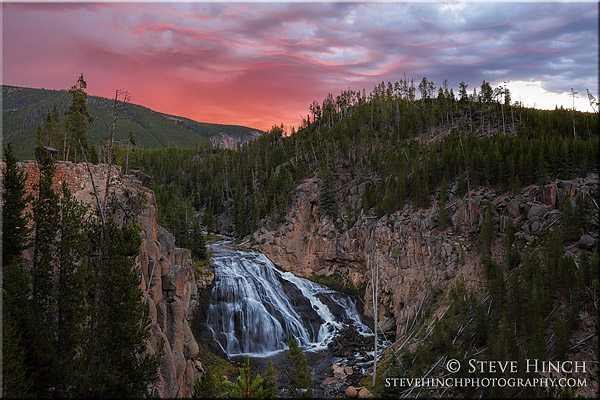
The image above was taken back in August of Gibbon Falls in Yellowstone National Park. Even the most epic sunrises have limitations on what makes a suitable foreground and on this morning there was some brilliant color in the sky… in the wrong places for the best foregrounds. I took a look around and thought perhaps the color would show behind Gibbon Falls but of course I would need to get there before the color faded. I made it with a few minutes to spare.
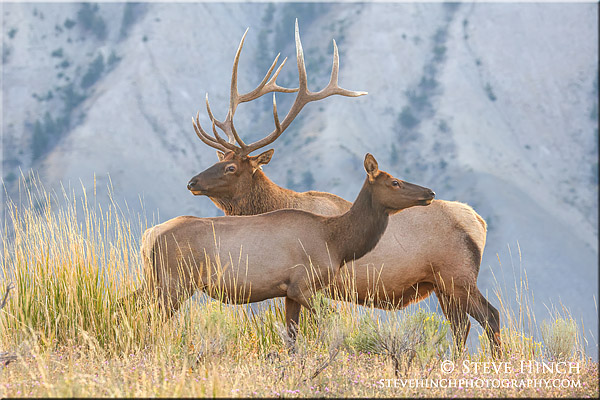
Bull and Cow Elk. Canon R5, 400mm, beanbag, 1/250 @ f8, ISO 1600
Back in September I had posted some elk images from the rut and intended to share more but time got away from me. It was a busy autumn with elk, moose, and beautiful foliage. Now of course, the snow is falling and the landscape is taking on a whole new beauty. The image above was taken in Yellowstone at the beginning of the elk rut. The bull was very interested in the cow as she moved past him.
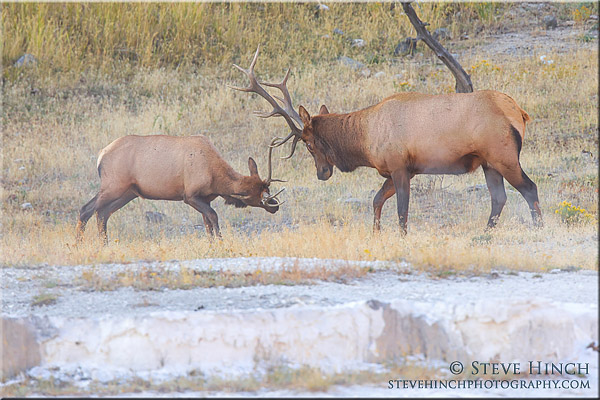
Young Bull versus Mature Bull. Canon R5, 500mm + 1.4 teleconverter, beanbag, 1/400 @ f8, ISO 1600
Back in September I had posted an image of these two sparring but thought this image better showed the size difference between the young bull versus the mature bull. The larger bull patiently stood there hold his antlers steady while the little guy went to town. It was quite interesting to watch.
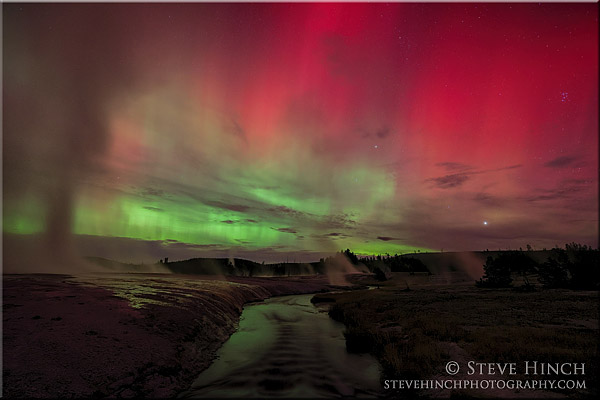
Aurora over Iron Spring Creek, Yellowstone. Canon R5, 16mm, tripod, 15 seconds @ f5.6, ISO 3200
I’ve missed a few opportunities to photograph the aurora borealis over the last few months for a variety of reasons so when the forecast for a significant display popped up, I decided to head out. The weather forecast was for cloudy skies but fortunately it didn’t hold up and the skies began to clear. The above scene was one had planned for an aurora shoot.
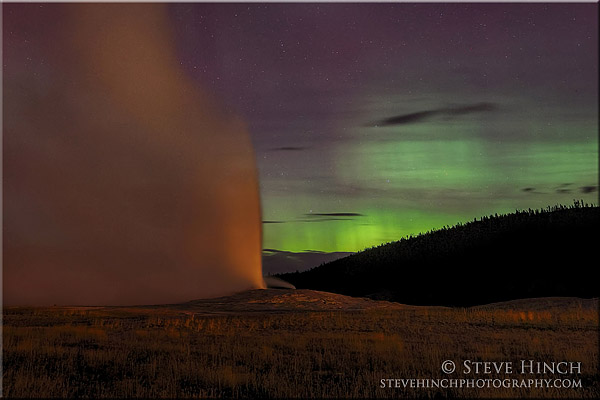
Aurora behind Old Faithful. Canon R5, 24mm, tripod, 15 seconds @ f5.6, ISO 3200
I’ve only shot Old Faithful during an aurora event once before and wasn’t happy with the results. I’ve tried other times but there are usually people shining flashlights on it at night. There were quite a few people waiting for the geyser to erupt while watching the northern lights but fortunately no one put a light on the geyser. The red color on the geyser is due to lights on at the Old Faithful Lodge, to my right.
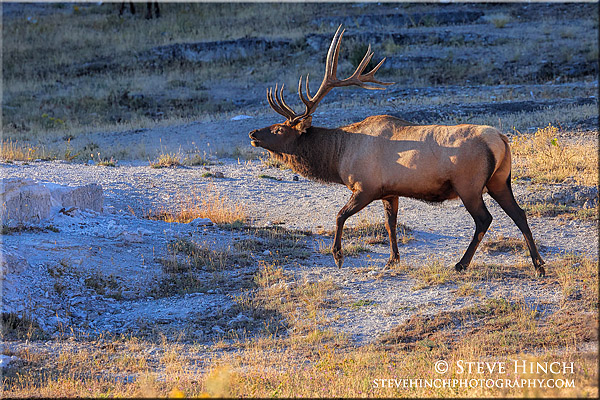
Two Young Bull Elk Practicing for the Big Time. Canon R5, 500mm + 1.4 Teleconverter, beanbag, 1/500 @ f8, ISO 1600
Late July through August is the time for the bison breeding season but when September comes around, it becomes the elk’s season in the spotlight. I was recently at Mammoth Hot Springs and watched as these two smaller bull elk practiced their fighting skills. It was actually quite interesting as the larger bull, on the left, would just lower his antlers and let the little guy do his thing. There was no aggression and was more like a training session, especially for the young bull.
That is until the big bull woke up and chased the two smaller guys off. He checked the females and then walked back to find a comfy spot to lay back down. The Park Service was signs all over warning people to stay back from the elk, but too many people ignore them and people do get injured when they get too close. Bull elk are very aggressive and unpredictable at all times but especially during the breeding season. I’ve gone back up a few more times but unfortunately the elk have been either among the buildings or in areas where it wasn’t great for photos.
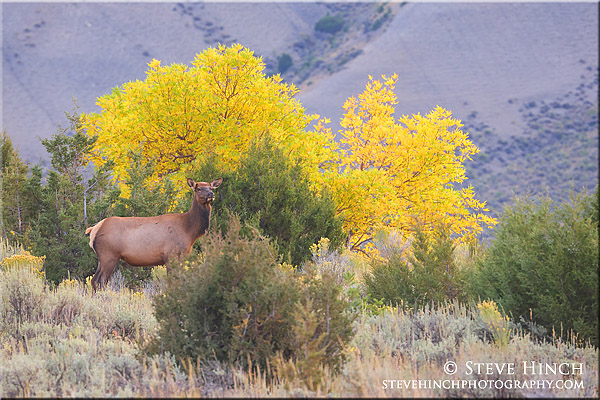
Cow Elk with Autumn Cottonwood Tree. Canon R5, 400mm, handheld, 1/200 @ f8, ISO 1600
This photo was taken this past Sunday. One bull was working a meadow to the north of the terraces but there was no parking and I wasn’t going to stop in the road even though several others thought it was fine to do so. Another large bull was resting down among some houses. I opted to go and walk around the terraces to shoot some landscapes but notice a couple of cow elk about to pass by this cottonwood tree in full autumn color, providing the only elk photos of the day.
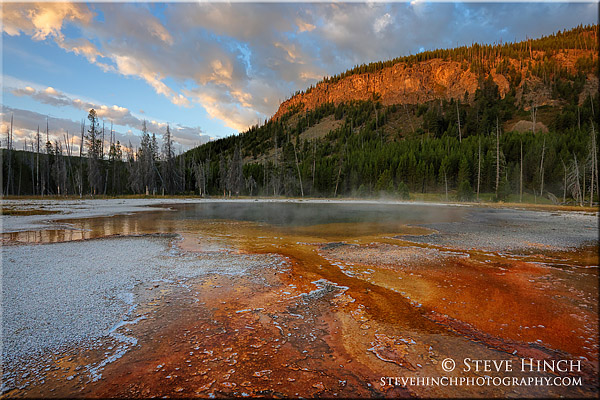
Emerald Pool. Canon R5, 16mm, handheld, 1/200 @ f11, ISO 1600
Biscuit Basin in Yellowstone National Park was my “go to” spot at sunrise on days when I had a print signing at the Old Faithful Inn this past summer. But when a steam explosion closed it for the summer, it had me checking out other locations at sunrise. Black Sand Basin has always been a secondary “go to” and this hot spring called Emerald Pool was always a favorite. But getting there earlier than usual allowed me a chance to capture this image with the very first light painting the ridge in the background. A slight breeze moved the steam to the side instead of obscuring the background which certainly worked for this image.
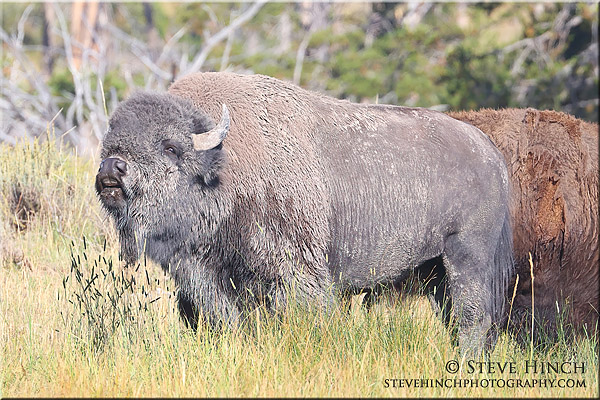
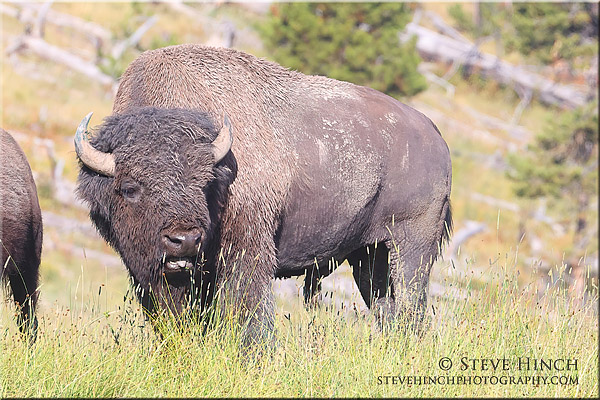
Back in the Spring, the sighting of a white bison calf in Yellowstone garnered a lot of attention. Unfortunately beyond that initial sighting, it wasn’t seen again to my knowledge. But during the bison’s annual breeding season, or rut, which occurs in late July through August, the bulls will roll in dust and mud, often coating themselves and making them appear white. After a few rainy days which turned all the dust wallows into mud, many of the bulls were covered in dirt with this one being perhaps the whitest, or at least dirtiest of the bunch. The bull below is slightly cleaner.
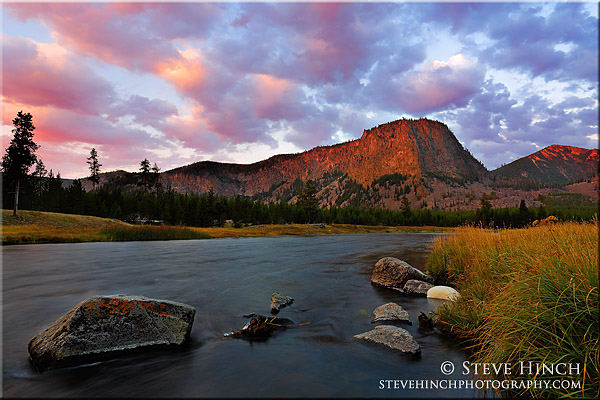
Mount Haynes and the Madison River. Canon 5D 3, 21mm, tripod, 2 seconds @ f22, ISO 100
omorrow, Wednesday, August 14 brings me to the last four book and print signings of the summer in Yellowstone National Park. I’ve had a lot of requests this summer for landscape photos so I decided to add several new images to the display for this month, including the three seen here. Above, a sunrise view of Mount Haynes towering over the Madison River made the selection. While I have plenty of images of Mount Haynes, which isn’t actually a mountain but rather an ancient lava flow, this one appealed to me the most due to the light on the cliffs and the colorful clouds.
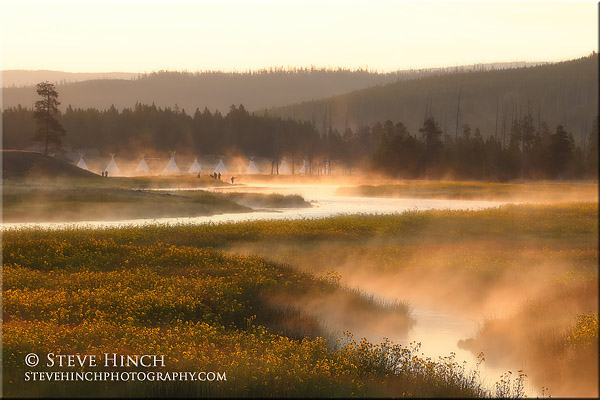
Teepees at Madison Junction. Canon R5, 105mm, handheld, 1/500mm @ f11, ISO 1600
This next image was taking a couple of summers ago when they did the teepee displays in a few places in the park, one of them being the amphitheater at Madison Junction. These scene really didn’t need anything extra to make it beautiful and honestly, I had hoped there was enough fog in the background to obscure the teepees as it was the foreground that brought me to this spot. And then of course I wasn’t thrilled with the people walking around. That is until I came back to this image on the computer. The foreground is great but I feel this image grabbed a piece of the past, depicting a native American village along the river. The people walking around only added to that feeling and gave it life.
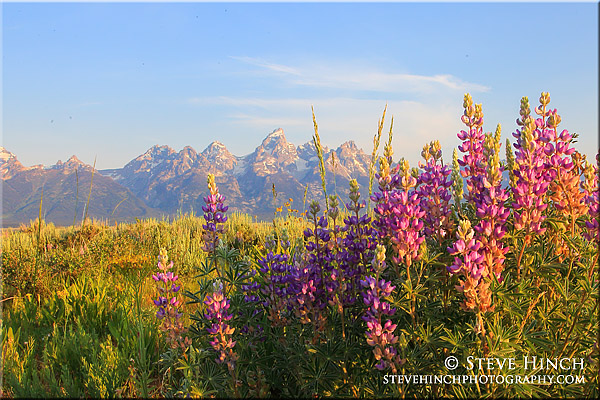
Lupine and the Teton Range. Canon 5D2, 28mm, tripod, 1/60 @ f22, ISO 400
Finally, I opted this image from Grand Teton National Park. Yes, I stock a few images during my signings from Grand Tetons, since it’s the sister park to Yellowstone. And I’ve had a hard time keeping them in stock. I went through some summer images and really liked this one with the low angle and lupine grabbing the scene, balancing it out nicely. As I wrap up the summer signings this month, I’ll take a good look at what I’ll stock up for next summer and perhaps add some more new products as well.
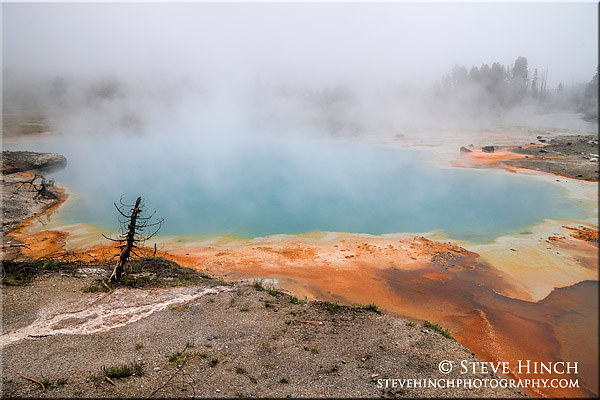
Wall Pool, part of the series of hot springs that include Black Diamond and Black Opal, was created by steam explosions between 1902 and 1912.
Biscuit Basin in Yellowstone National Park made headline news last week when a geothermal explosion of Black Diamond Pool sent visitors fleeing. The small geyser basin will remain closed for the rest of the summer. Geothermal explosions are not a rare occurrence in Yellowstone and, according to park geologist Mike Poland, happen as frequently as one or two times a year. Black Diamond Pool had previously experienced a steam, or geothermal, explosion in 2009 and Porkchop Geyser in Norris Geyser Basin exploded in 1989. In fact, at Biscuit Basin, the entire Wall Pool/Black Diamond Pool/ Black Opal Pool complex were created by steam explosions that occurred between 1902 through 1934, according to the book The Geysers of Yellowstone by T. Scott Bryan.
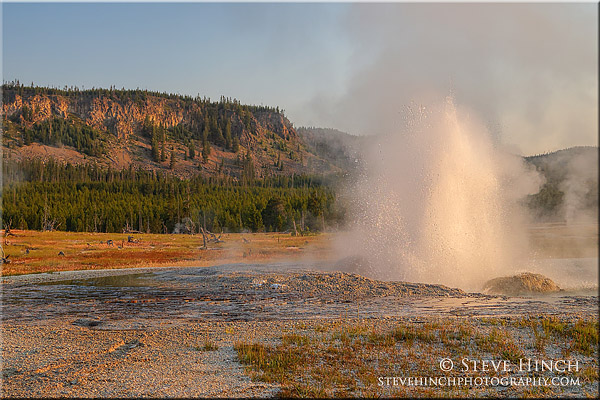
Jewel Geyser in Biscuit Basin. Jewel erupts on average every 4 to 12 minutes in a series of 1 to 10 bursts.
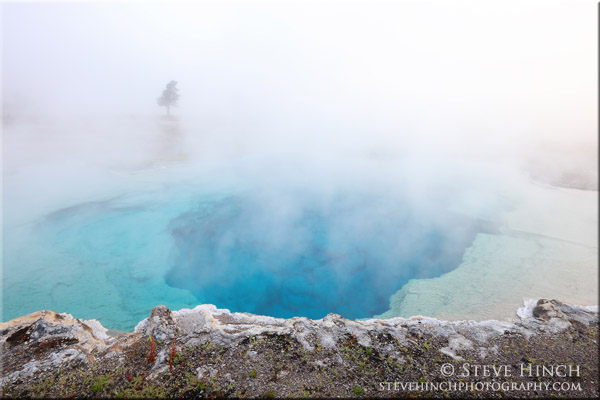
Biscuit Basin is one of my “go to” locations for sunrise when I have a book/print signing in the lobby of the Old Faithful Inn. The lead photo to this article depicts what was Wall Pool prior to the July 23rd steam explosion. Based on aerial photographs provided by the National Park Service, it appears Wall Pool and Black Diamond Pool are now one large pool and the Park Service, at least for now, has labeled it Black Diamond Pool. Above, Jewel Geyser is largest of a couple of small but regular geysers that can be found at Biscuit Basin. And below is Sapphire Pool, arguably one of the prettiest hot springs in Yellowstone. Though it sits only a few dozen yards from the Black Diamond Complex, based on aerial images, it appears unaffected by the event of July 23rd.
Sapphire Pool. Based on aerial images, this pool appears largely unchanged by the events at nearby Black Diamond Pool, just several yards to the east.


 steve hinch photography